
01 "Matcha-Specific" Premium Black Granite - Curved Rhombus 16-Sided Design - Chisel Finish Polished
This is a page for international customers.
Product price $888 €740
Product Description
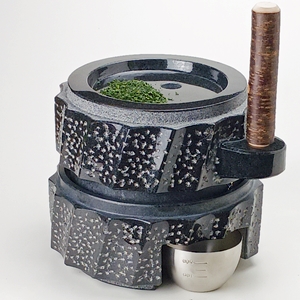
When you first touch this millstone, the sensation that comes through is its unmistakable weight.
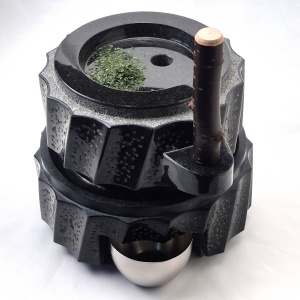
It is crafted from exceptionally rare, high-grade black granite.
The crystal structure is extremely fine, and its density is higher than that of ordinary granite.
This density creates a calm and stable grinding motion.
The finish is inspired by the waves rising from the sea of Amakusa.
Rather than decoration, it captures the rhythm of nature itself.
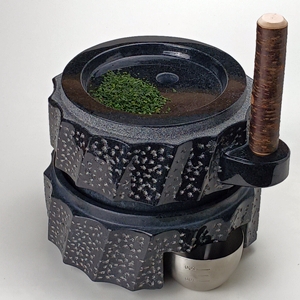
The handle is made from natural cherry wood, adding a gentle warmth to the cool stone.
When quality is given priority, the mill grinds approximately one gram per minute.
This is a pace chosen not for speed, but for aroma and the beauty of the resulting particles.
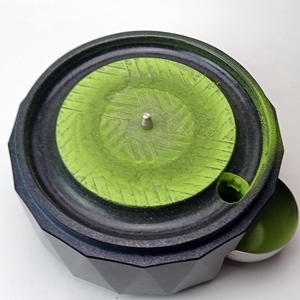
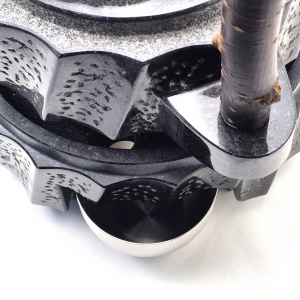
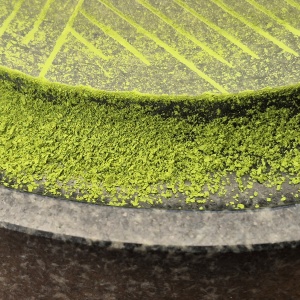
The ground powder naturally falls into the grooves of the lower millstone.
A 30 mm-wide brush attached to the upper millstone quietly gathers the powder.
The brush typically requires replacement only once every several years.
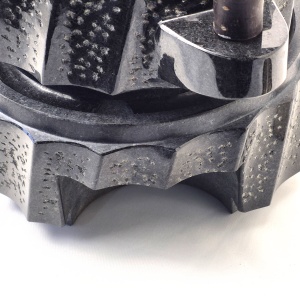
Both the upper and lower millstones feature a subtle stepped edge at the base.
This detail allows your fingers to find a natural grip when lifting.
The central shaft is made of stainless steel and is resistant to wear.
The interior is equally durable, eliminating the need for re-sharpening.
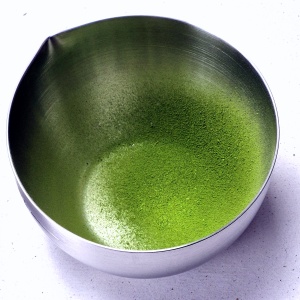
Included is a stainless steel cup designed to reduce static electricity.
The completeness of this tool reveals itself in such carefully considered details.
Notes on Use
The matcha produced by the millstone collects in the grooves,
where it is automatically gathered by the brush attached to the upper millstone.
It then falls through an opening in the groove directly into the container below.
Please clean the interior after each use.
This is a tool that becomes complete through time spent with its owner.
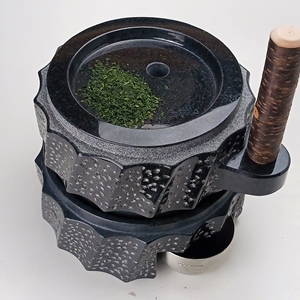
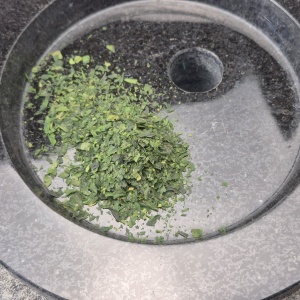
When grinding tencha, place the entire amount of tea leaves into the opening before you begin turning the mill.
Although the mill is adjusted for tencha, gyokuro and similar teas can also be ground by adjusting the quantity used.
In rare cases, tea leaves may remain inside the opening.
If this occurs, gently push them through using chopsticks or a similar tool.
Product Details
Consumption tax: Tax-exempt product
Shipping: Covered by our company
Height: Approx. 21 cm (excluding handle rod)
Weight: Upper millstone 10.5 kg / Lower millstone 12.5 kg / Total 23.0 kg
Handle: Natural cherry wood
Delivery time: 2?3 days if in stock / Approx. 10 days for made-to-order production
Payment method: Online credit card payment (PayPal)
| International Shipping Fees | Air Mail | Sea Mail |
|---|---|---|
| Asia | $189 / Approx. 10 days /UPS/ International Mail | $93 / Approx. 25+ days / International Mail |
| USA | $260 / Approx. 10 days / UPS | $132 / Approx. 40+ days / International Mail |
| Europe | €291 / Approx. 10 days / UPS/International Mail | €85 / Approx. 50+ days / International Mail |

Production
The stone used is an exceptionally rare "premium black granite." This stone is characterized by its lack of crystalline grains and its higher specific gravity compared to other granites.
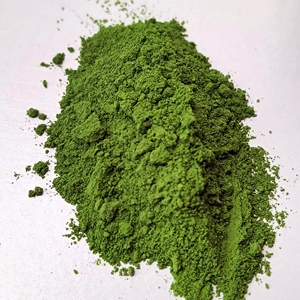
This is a stone mill specifically designed for grinding tencha into fine matcha powder.
With standard stone mills, grinding fine powder requires carefully feeding the tea leaves in small amounts. However, my matcha mill allows you to add the entire desired quantity of tea leaves, and simply continue turning the upper millstone to produce fine matcha powder effortlessly.
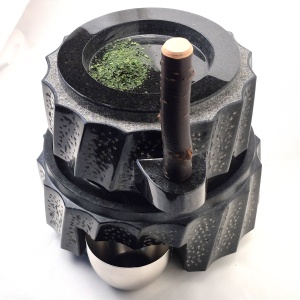
The exterior design is divided into 16 equal sections around the circumference, forming a twisted rhombus shape.
The surface is textured with a chisel to represent the waves of the Amakusa Sea, and then further refined and polished to reflect light.
This process results in a subtle reflection across the entire surface, and the irregular chisel marks add a unique and distinctive character.
The upper millstone is designed to hold enough material for two servings (approximately 20g) at a time. However, it can be used repeatedly to grind larger quantities without generating heat, which could cause "burning" and affect the flavor. (Excessive heat is known to increase bitterness in coffee and other materials.)
The grinding surface diameter was determined through trials to ensure sufficient grinding capacity without over-grinding and is set at 5.0 sun (approximately 15 cm). The height of the upper millstone was calculated based on the required weight.
The lower millstone features a donut-shaped groove around the outer edge of the 5.0 sun (15 cm) grinding surface. This groove is 8?9 bu wide (24?27 mm) and 5 bu deep (15 mm), designed to collect the ground powder.
The donut-shaped groove includes a single "hole," through which ground powder is swept by a "brush" attached to the underside of the upper millstone. With each rotation, the powder falls through the hole into the groove.
The "hole" in the lower millstone is crafted to accommodate a "tray," with dimensions of 10 cm width, 10 cm depth, and 6 cm height. This design determines the height of the lower millstone.
Detailed Design Specifications
The stone used is an exceptionally rare "premium black granite." This stone is characterized by its lack of crystalline grains and its higher specific gravity compared to other granites. In general, matcha mills require users to add tea leaves gradually while grinding. However, if the amount added is not consistent, the particle size of the matcha can vary. My matcha mill is specifically designed for grinding matcha only, ensuring that even those unfamiliar with using stone mills can produce uniformly ground matcha. To use, simply add all the tea leaves (tencha) you wish to grind into the top hole of the mill. Then, continue turning the upper millstone. The ground matcha is collected by an attached brush and directed into the container, making the process efficient and user-friendly.
The position of the hole relative to the center point also plays a role in grinding performance and efficiency. While it might seem that ground powder exits from all around the millstone's circumference, observation reveals that it only discharges from one specific spot on the upper millstone. Because this spot rotates, it creates the appearance of uniform discharge across the entire circumference. This specific spot on the upper millstone is located between 45 and 90 degrees counterclockwise from the handle attachment point. The reason for this range lies in the pressure distribution on the grinding surfaces. When the millstone is stationary, the pressure is evenly distributed. However, when the handle is attached and held with the right hand, additional force is applied to the handle attachment area, increasing pressure in that region. This increased pressure at one spot causes a decrease in pressure on the opposite side of the grinding surface. When the millstone rotates, the high-pressure area prevents the powder from entering, so the powder is pushed out slightly before reaching the high-pressure zone. The area where the coffee beans are first crushed often causes the upper millstone to lift slightly. To counteract this, the crushing force must be aligned with the line connecting the handle and the center point. Since the handle generates force not directly downward but angled toward the rotation direction, the hole must be located 90 degrees forward in the direction of rotation from the handle attachment. Both the size and position of the hole are determined based on careful observation, imagining the internal flow of the powder, and verification through prototypes and testing.
A common misconception is that the upper and lower grinding surfaces are entirely in contact. In reality, only a portion near the outer edge is in contact, with a gradually widening space extending inward toward the center. Materials fed into the millstone are crushed into smaller pieces step by step, eventually turning into powder at the outer edge and being discharged. This step-by-step grinding process is influenced by the structure of the "fukumi" (space), which is designed to narrow progressively to ensure materials are crushed into increasingly smaller particles. When grinding larger materials such as soybeans, the depth of the fukumi needs to be greater, ideally about half the diameter of the material. For smaller materials like sesame seeds, the depth of the fukumi is minimal or nearly nonexistent. Understanding the function of the fukumi and designing it with precise and adequate dimensions is crucial. If the fukumi is not properly designed, it can lead to issues such as large amounts of material remaining inside the millstone after grinding, or materials not entering the grinding space at all, causing them to simply spin around at the bottom of the "material feed hole" without being ground.
A brush, hidden beneath the handle of the upper millstone, collects the ground powder during rotation. The powder is automatically deposited into a container through a hole in the groove designed to catch it. When grinding coffee beans, a small amount of powder may scatter. To prevent this, the grinding surface is recessed below the outer edge of the powder groove. This requires precise machining, but it effectively minimizes powder scattering around the millstone. Note: For matcha millstones, there is no powder scattering, so the grinding surface does not require this recessed design.
